
Editing my Father
What is lost and also found

Hello friends, this spring has been beautiful and slooow; even yesterday we had a frost and tiny snow flurries at the farm. I have entered the season where writing mostly doesn’t make it on the list, my body is moving too fast and my thoughts are fragmented by the busyness. I think a lot about my father, who died here as summer was dwindling last year. Tomorrow I am going to England to see my aunts and uncles, to check in with everyone left in my parents’ generation. There is also something happening in my father’s honor at Oxford. I’m not sure what it is, yet - it’s the vision of a dear friend as a way to celebrate the many things my father loved. His friend asked to prepare something to share, and so I’m sharing his love (and struggle) with writing. For now, it’s all I got…. xo Helen
My father wrote on Fridays. In his L.A. days, Friday was his day off from the hospital and we would talk about his book, American Mania, and later, The Well Tuned Brain. Long before, when we all lived in Plainfield, my father wrote in his small study surrounded by books and I’d push open the old door mostly to say goodnight or to sneak chunks of ginger from the crock by his reading chair. I think he wrote in the early mornings or into the evening, and he smoked a pipe then, only mostly he’d just hold it in his teeth without lighting it. I loved the smell of his unlit tobacco but not as much as I loved my grandfather’s, which was sweet and came in green tins with fancy lettering that my sister, Kate, and I would turn into special burrows for our pet mice, who were really pussy willows, on the rare occasion that we met our grandfather, who lived in England.
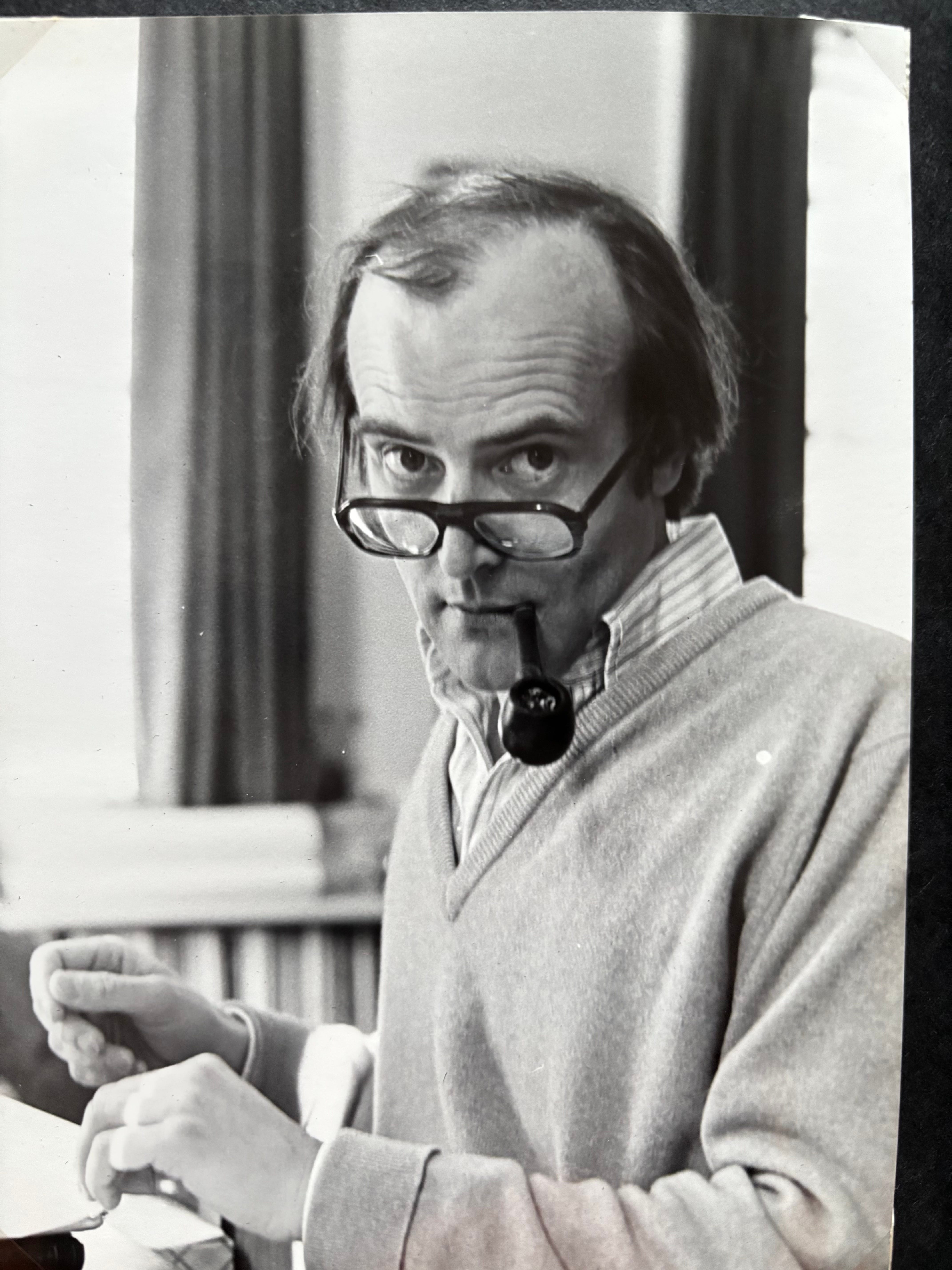
By the time my father wrote in his apartment in Los Angeles on Fridays, he had long ago given up the pipe. He still had his jar of ginger. And he still – always - wrote his first ideas in large hardcover notebooks, in different colored pens. My father loved pens. On his writing desk he always had three: black, red and blue. Occasionally in his notes he would use green, but the other three colors he ordered a dozen at a time and when he died we found the brand-new boxes of all the pens he would never use up.
He must have used up hundreds of pens. He never did love the computer. When he was writing A Mood Apart, which was long enough ago that computers were clunky hard-wired affairs, his two-fingered battle to type it out, having never learned to type, resulted in a horribly deformed elbow that had to be drained, and so he went back to dictation. I remember him pacing back and forth around the house, dictating letters into a little machine with a tiny tape that he’d give to Fern Wilder, then Sharon Chavez, secretaries I got to know over the years – and they were called secretaries then – because my father was always late to things, like picking us up from school, and needed to be tracked down. Full stop, I remember hearing him say, and for a long time not knowing what it meant but I liked how it sounded.
My father’s writing notebooks are, as Joan Didion’s, “something private, about bits of the mind’s string too short to use, an indiscriminate and erratic assemblage with meaning only for its maker.” I struggle to read his loopy writing let alone understand what connections he is making, but I treasure the notebooks as maps of his unlimited curiosity as well as the source of a formative childhood memory. I wrote a lot of stories growing up, and later my fondness for literature forced me to write many school papers on annoying themes such as the symbol of bread in The Brothers Karamazov, a paper for some reason so torturous to write that it never left me.
There was no computer growing up, so I had to write everything out, correct it, then write it all out again. I was impatient with my own imperfections and would often have a fit, crumple the paper and throw it across the room, frustrated for myself for screwing up a sentence and being forced to write it all out again from the beginning of the page. How books ever got written before word processors is a great miracle to me. I think in many cases there were heroic literary wives, Sophias and Veras, along with other well-meaning ones who were not so helpful—Hadley, who left her husband’s complete works on a train. It has changed us to live in a world with back-up drives.
Anyway, one day when I was about thirteen, probably having lost his patience with my outbursts as I sat at the kitchen table scribbling, my father showed me his own writing notebooks. First of all, the binding is held together with tape (I am holding one now) because so many things are stuffed inside; quotes and post-its with reminders, tear-outs from magazines and letters from friends. The pages are full of these thought-maps he made, which look like Rube Goldberg contraptions but whose purpose is to simplify very complex ideas rather than the other way around. Each page is an osprey nest of crooked lines piled on one another and connected by colored arrows, boxes and swirls. Darwin anchoring it, or sometimes Adam Smith, with poets he loved like Frost and Rilke and Yeats lurking in the margins. That day so long ago, he showed me something like these pages, how often he had scratched out a word, or even slapped an X through the whole paragraph.
It’s part of writing to make a mess, he told me. I never forgot that.
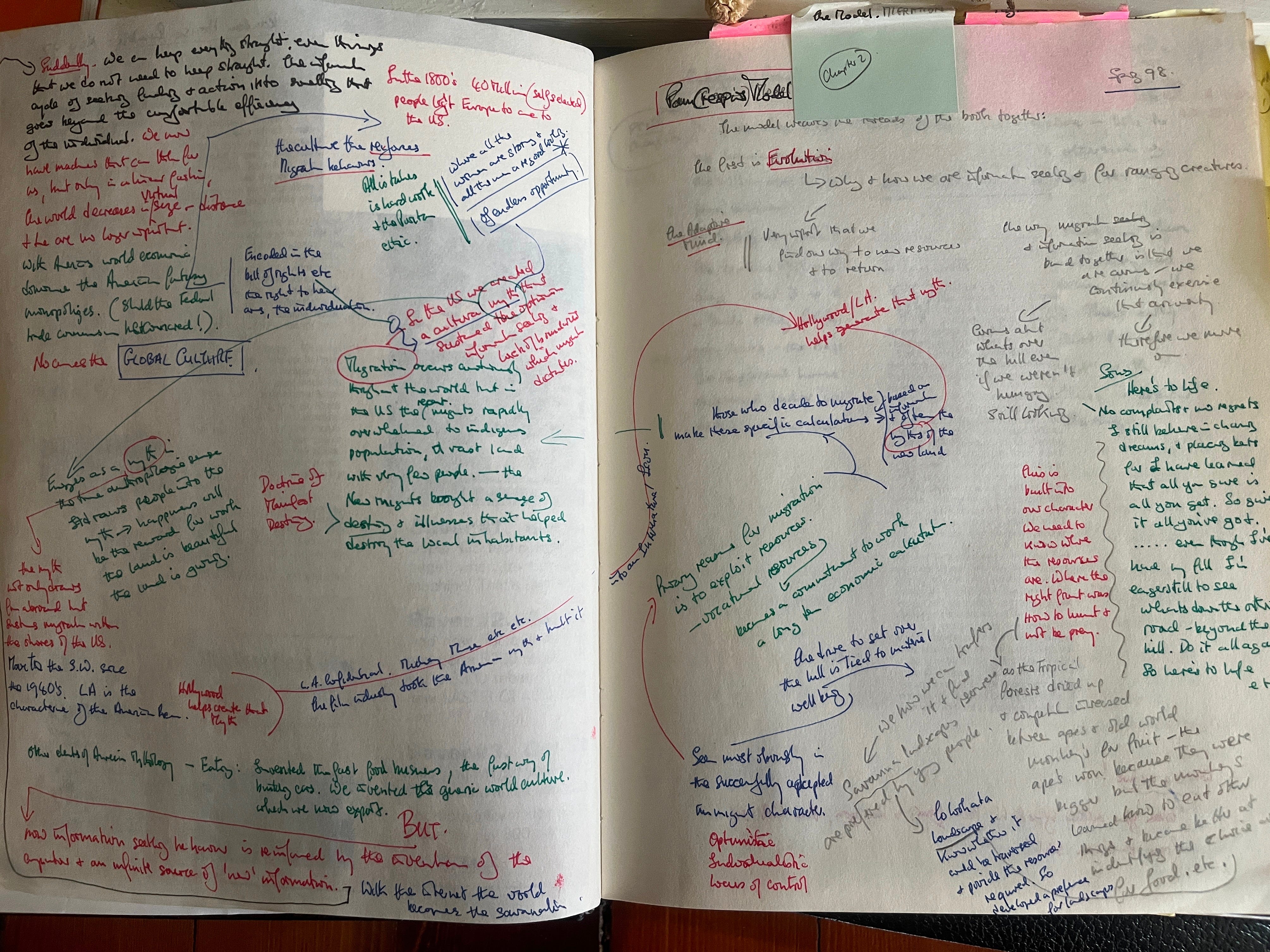
The great joy of getting to edit my father’s books was to glimpse and try to follow the workings of his omnivorous mind. My role was not to correct grammar or punctuation (though my father was overly fond of commas) but to translate into prose what beamed from a brain that seemed designed to see things through a Hubble-sized lens. As much as my own writing was becoming micro and concerned with the details of place, my father’s was becoming more expansive, covering the whole trajectory of Western thought, colonialism, industrialization, human migration and biology to grasp something important about the origin story of the mess of modern America. Biology is destiny, he felt, and our bodies are not designed to cope with many of the pressures of the modern world, causing all kinds of health issues, mental and physical. He was one of the first people to write about society’s impact on our brain chemistry. He came at all of this through his compassion for human suffering and his concern about mental health, but he was curious about everything across a great span of time and space. He always sought to know how everything was connected.
I was a young editor at W. W. Norton in New York in 1997 when American Mania was orphaned by both his agent at ICE who had abruptly changed companies, and his editor, Ann Godoff, at Random House who was abruptly fired, so I gave the manuscript to Donald Lamm, who picked it up at W. W. Norton. My father was much happier after that. He and Godoff had not seen eye to eye. Demonstrating perfectly his hypothesis that America was spinning too fast, she told him that “the hurdle you have too clear is that a book about our consuming mania is worth the precious time it takes to read….to my mind this needs to be a short book.”
I am not sure how much I helped my father to create those books, but he helped me become a good editor. My determination to understand his thinking well enough to translate it into less dense prose made me more intelligent, at least temporarily. I remember our many conversations on finding the sweet spot of readability without dumbing it all down. It’s a relief he didn’t work with Ann Godoff, who in addition to wanting a short book and cutting the chapter on human evolution said to him, “You need to provide a prescriptive conclusion.” “She prefers me as a shrink and would like self-help, maybe a pill,” my father said. He wasn’t having it.
Young as I was when I worked on his manuscripts, he gave me the gift of respect. This is powerful when it comes from a parent, but in fact any time a writer trusts an editor to help them ravel the ends of their thought, it is always an act of profound respect. I learned that it is the editor’s privilege to enter that relationship of sharing someone else’s creative process, not the other way around. This does not mean the editor should be timid, but they should also never be careless with the other’s words and ideas. In my mind, editors go off the rails when they try to shape authors’ hard work into some transitory idea of “commercial,” — the equivalent of taking something hand-carved and ditching it for the same shape from a 3-D printer. My father had lots to say about the pressures of a market culture and the erasure of creativity. He revered what was original, hand-made, expressive. He revered the work and devotion required to create something honest. He still wore suits someone had sewed for him as a student in London. Writing a book took him years. And his books were never short.
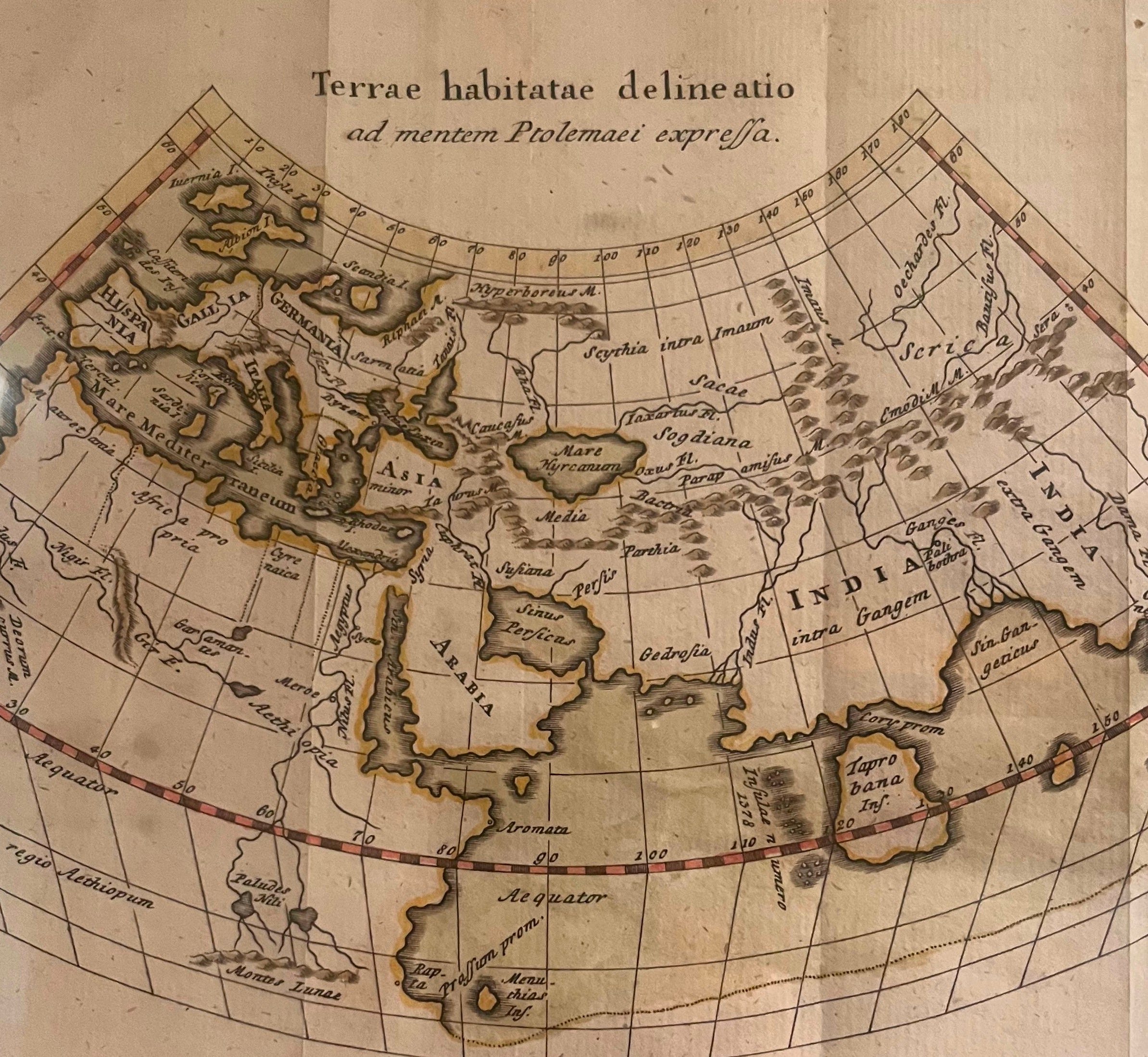
My father, of the many things he collected – old books (especially Darwin), chess sets, toy cars, pewter mugs, masks, cartoons, small erotic sculptures —perhaps most of all he had an obsession for maps. More than half of the pictures hanging on his walls were old maps – some many centuries old – of places he’d loved or lived: Hertfordshire, Oxfordshire, New England, London, Venice, Berlin. They look a lot like his notebooks, dense cross-hatches of meaning, lines capturing something that no longer is, that has changed form and is always changing form but is no less potent for having been seen and drawn in that moment of discovery. As a child, I loved to run my finger over the lines of the maps that hung in every room of the house, imagining all the people and animals who long ago traveled through the territory that a few faint lines still signify and hold sacred. What it describes is gone. But at one time it was animate. It was a whole world that someone studied and loved enough to describe on a page.
So rich. I wish I’d met your father. Still intend to get to know him through his writing. Thanks for being such a compassionate and truth seeking editor (a writer, obvs.)
Thank you for sharing. A lovely tribute and inspirational thoughts on writing.