
Chasing Crows
Plus some book news and The Belonging Book Club

Dear People,
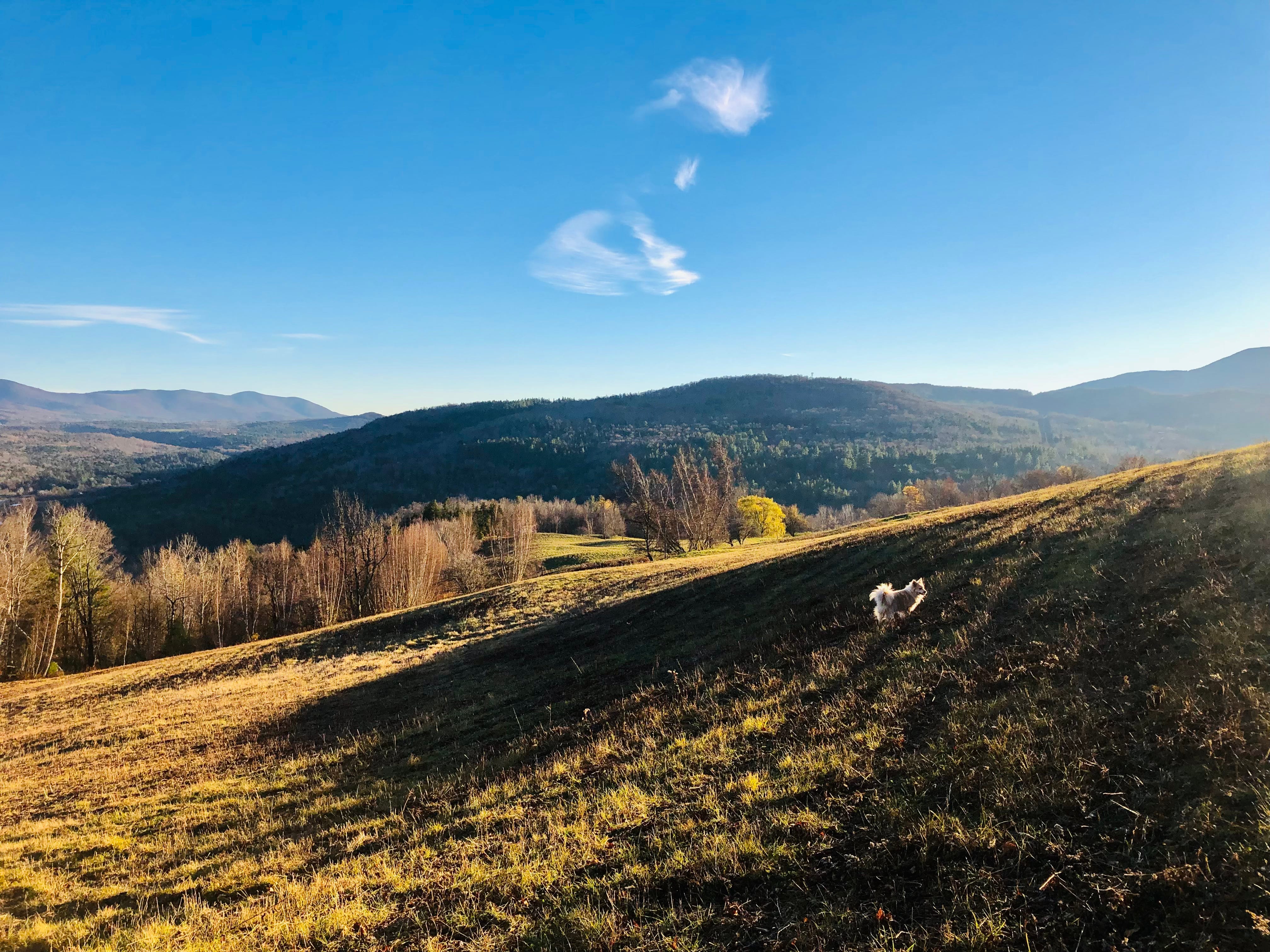
I’m back at my desk…..sort of. Typing is clumsy with a torn tendon in my right hand (surgery tomorrow will only make me more clumsy, I’m afraid, so I gotta get this done now). My thoughts are two paragraphs ahead of my two working fingers, which may never catch up before my ideas are indecipherable specs in the clouds—like Machias barking at crows who leave the field miles before he gets to them but still he hurtles every hair of his small body at the sky, undeterred.
I need to be undeterred. Never does that pup come back discouraged; every utterly hopeless crow-chase delights him and makes for a good day. The ecstasy of being animal! If Machias could philosophize out loud, he’d say, “Do not NOT chase crows because you think you don’t stand a chance of catching them. The chase is it.” As a writer, this is how I aspire to be.
Truth is, chasing words helps me keep on even when, as now, any hope of capturing meaning seems impossible. This has been an autumn of endings. As I write this, a 100-foot tall cottonwood tree is being disassembled and passing by the window in pieces, the same window my father last looked out of a few sad weeks ago. As much as there is to say about the death of a father and of a giant tree, I can’t write about it now. Maybe someday. This fall has had too many endings for me, is full of too many absences, and I need to lift from this limb of sadness and fly to another place for a while. I can’t make any sense of all the loss. That human condition, again.
I’ve never been one for escapes but sometimes I think it’s okay to look out another window for a while.
So, I’m going to share some book news, and then tell you about a new project I’m launching called The Belonging Book Club, where I hope we can be in conversation with each other as we read this winter.
Book News
Jean Giono - By now, you may know that I’m a devotee of Jean Giono, a French novelist who wrote between the World Wars, a pacifist and a mystic who was deeply connected to the land in Haute-Provence, a place he rarely left. The reason I so love his writing might be best summed up by Edmund White: Giono, who was most interested in writing about the life of rural peasants and of nature itself, “was always emphasizing the universal aspect of his characters’ experiences, the exhilaration of being an animal and the tragedy of being a human being.”
Thanks to those of you who read The Salt Stones and went looking for the Giono novella that served as part of my muse, the English translation of The Serpent of Stars is coming back into print. Archipelago Books has raised funds to reprint it in 2026. The book’s brilliant translator, Jody Gladding, and I are throwing a party to celebrate at the Highland Arts Center in Greensboro, Vermont this spring, which will include an art exhibit of pastoral painting and prints by working shepherds and farmers – including my daughter, Wren. (Details to come on my website).
The National Book Awards - Although I was a longlister (one of ten chosen for nonfiction) and therefore not at the awards ceremony in New York (I was sorry to miss George Saunders!), which is for the final five, I was thrilled to be part of the full National Book Foundation celebration at the Miami Book Fair in November. All finalists in Nonfiction, Fiction, Young Adult and Translation came together for a “grand slam” reading – 2 minutes to read followed by a pop question. So much fun! I got chills listening to some authors read….just one or two paragraphs, and I was entirely swept away into another world. It was powerful stuff. I was especially moved by the YA Fiction writers – Ibi Zoboi, Amber McBride, Mahogany Browne – writing about empowerment and belonging and coming of age. What a gift their writing is to all the young people trying to find their way in the face of the endless crazy shit that goes down when you are black or brown skinned in this world. The Nigerian poet Gbenga Adesina made me cry with a poem from his collection, Death Does Not End at the Sea. (All things death seem to speak to me these days, I won’t deny it.) Several National Book Award titles will be on my book club this winter and I can’t wait to share my thoughts.
The New Yorker gave a shout out to The Salt Stones on their Best Books of the Year List. *&!*??! I never in a million years thought I’d show up in those wafer thin, silk bowtie-attired pages. (As a lit-head, I’ve always held TNY in very high esteem, even while its elitism kinda kills me.) Here’s what they said.
The Salt Stones
by Helen Whybrow (Milkweed Editions)
Nonfiction
Continuity and loss form the twin themes of this memoir, long-listed for the National Book Award, which recounts the author’s experience running a small family sheep farm in Vermont. Shepherding, Whybrow writes, is not so much a way of life as a “way of being,” encompassing both wandering and home, isolation and community, uncertainty and joy. Over the decades, Whybrow’s flock experiences great dramas—stillbirths, coyote attacks—but their connection to the landscape sustains them. Less fortunate are the humans in their orbit, among them Whybrow’s mother, who, afflicted with dementia, must leave her own home for an assisted-living facility. Whybrow is uniquely positioned to understand what humans have lost in severing their bond with nature, yet her message is more hopeful than bleak: healing, she writes, “is not about returning to what was, but about accepting the change and adapting to the brokenness.”
Finally, letters. So many friends and strangers have written to me about their lives, their farms, their parent with dementia, the places and ways and struggles in which my words found them. A young friend wrote these lines, in my mind the best lines any writer could hear: “I was going through a rocky period with a friendship, so it was nice to have something so grounded and true to come back to each night. Something I loved, felt I could lean on, felt it would hold me up, felt it would be okay.” Yes! My goal was to write a consolation and a remedy. (Thank you SO much, Pia. You’ll be getting a letter back from me soon.
And Now….Announcing The Belonging Book Club, starting Jan, 2026
As I write in The Salt Stones, the feeling of belonging—what exactly it is, where it is found, how important it is and why—has preoccupied me most of my life. For me, belonging is always inextricable with land and nature, and it includes the tension of rooting in one place and longing for elsewhere, of the innate urge to explore what’s beyond place and self. I have always had this tension between being a nomad and being devoted to creating a home, and I know I am not alone in this.
This is the inspiration for a book club where, each month, I will read a book that in some way speaks to me of this dynamic theme of belonging. I’ll write my thoughts about the book, pose some questions, and invite anyone who wants to join to be part of a wide-open conversation. The books will be diverse – all genres, many angles on the theme – and I’ll also invite guests to share their thoughts about their chosen books; it won’t always be me, because I want to be surprised, too.
The first month will be free for everyone, so you can see how it rolls. If you enjoy it, I hope you’ll subscribe, and for $5 per month you can keep getting all the book recommendations and conversations. I invite you to incorporate my posts into an existing book club that you are part of, to seed ideas for your book choices and prompt discussions with your friends. My greatest hope is that it will also help us think about belonging in our lives, how we each find it for ourselves, and how we can create it for others. Together we will come up with a Belonging Reading List. Ultimately, my goal is for the non-human world to benefit too, as we practice truly understanding our place as one small piece of this intelligent and beautiful planet.
Anyway, dear people, that’s all I got on this bright and snowy, one-handed day.
Please practice care, be strong, and stay tuned. Appreciate you for listening!
I finished The Salt Stones this morning, and it is my favorite book for 2025. I live on 5 acres in an agricultural valley of the PNW Cascade foothills where I spend spring, summer and fall growing vegetables, fruit, and medicinal herbs. Though I don't have animals, except two dogs, one who sprints out to the pasture each morning to inspect/smell who had the audicity to travel through his pasture over night, and the other who barks at the ravens who fly overhead, your writing about your sense of place, your heft of place, resonated with me deeply. I am 67 this week, and thinking about moving this past year, back to an urban environment, but now I am rethinking it. Would I wither away in the city? Thank you for such a beautiful book! I am looking forward to the book club.
The New Yorker! Excellent. And delighted about the book club. Sounds like belonging.